Believe in the Resurrection
Series: John, After the Farewell Discourse Passage: John 20:1–10
Introduction
(Read Text) There are a lot of cheesy Christian movies out there. I can’t take many of them. But I really enjoyed was The Case for Christ. It tells the true story of Lee Strobel’s conversion. When it begins, Strobel is an investigative journalist for the Chicago Tribune. He is also a committed atheist and an ungodly one at that. Strobel has said, “I lived an immoral, drunken, profane, narcissistic, self-destructive kind of life."
So, he was horrified when his wife heard the gospel and got saved. She was on fire, growing in Christ, and he couldn’t stand it. So, he went on a mission to convince her that Christianity is a lie. He thought the best way to prove it was to expose Christianity’s central event—the resurrection. For two years, he put his investigative journalism abilities to work, sure he could disprove the resurrection.
But his investigation didn’t go as he expected. The more he dug, the more credible the resurrection appeared. Strobel was stubborn, but eventually he broke down. The resurrection happened. That means Jesus is Lord and Savior. So, by God’s grace, Strobel believed, he got saved, and he became a pastor and a successful Christian apologist. Among other things, his book The Case for Christ has sold over 5 million copies.
His testimony is an amazing, faith-affirming story. And it reflects the importance of today’s passage. If John is lying, we might as well all go home and give up on Christianity. But if our text is true, and God raised Jesus from the dead, Christianity is true, and you must believe. I hope you will. If you already do, I hope your faith will grow even stronger.
That’s John’s goal. Have you ever noticed that none of the Gospel accounts of Jesus’ resurrection say anything about its theological significance. They leave that to the epistles. Their only focus is to relay credible eyewitnesses accounts of what happened. Of course, John gets to tell you his own story, what he saw and how he came to believe.
Remember that John is an old man by the time he writes. I’m sure he had told this story many times. I’m sure plenty of people had laughed in his face. And I’m sure he had heard every objection in the book. But John knew what he experienced. So, he’s going to tell you what happened, and he is going to trust the Spirit to help you believe. But his story begins with Mary Magdalene. Verses 1–2 say…
I. Mary grieved (vv. 1–2).
Mary is a fascinating lady. “The twelve were with Him, and also some women who had been healed of evil spirits and sicknesses: Mary who was called Magdalene, from whom seven demons had gone out, and Joanna the wife of Chuza, Herod’s steward, and Susanna, and many others who were contributing to their support out of their private means” (Luke 8:1–3).
Mary had a dark past. Jesus delivered her from 7 demons! But she potentially also had some wealth since she helped support Jesus and the 12. She loved Jesus, and she followed him everywhere, including, as we saw last week, all the way to the cross and the grave. She watched Joseph and Nicodemus prepare Jesus’ body and put it in the tomb.
But the Sabbath began, and apparently, Mary and several other ladies wanted to do more to honor Jesus’ body. So, they planned to return on Sunday and finish the process.
John says Mary came “on the first day of the week…while it was still dark.” The other Gospels say Mary was with other ladies, and she acknowledges that in v. 2 when she says, “We do not know where they have laid Him.” The other Gospels also say they came early in the morning, probably when the sun was just starting to rise and break the darkness.
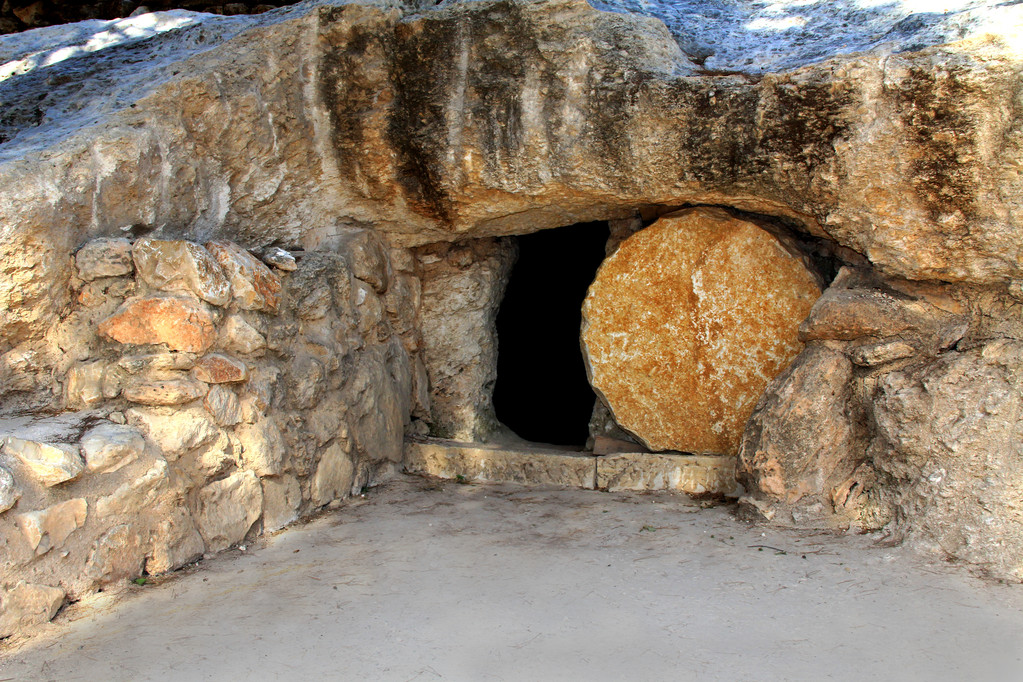
Mark says they wondered how they were going to remove the stone. That seems like an important detail for meeting their objective. But when they reach the tomb, they are shocked to see that it has “already (been) taken away from the tomb.”
I want to take a moment to brag on one of our teens. A few weeks ago, he came up to me after the service and asked why there was a star in one of the verses we had studied. I loved that he noticed, and I loved that he asked. But I hadn’t noticed the star, and I didn’t have an answer for him.
But I do now, and if you are holding a NASB, did you notice that there are 6 stars in vv. 1–2? What do they mean? After that teen asked, I looked in the Foreword to my Bible, and it said a star indicates a historical present verb. So, whenever you see a star, the author is using the present tense to talk about something in the past.
In the Greek it conveys vividness—the author wants you to feel like you were there and to feel all the emotions of the character. But it would sound strange to us if the text read, “Mary Magdalene is coming early…while it is still dark and is seeing the stone…and is running and coming…and saying.” So, it’s translated in the past tense but with a star to let you know the verb is in the present.
So, what’s the point? The point is that John wants you to feel the intensity of the moment. He wants you to feel to flood of emotion these women felt when they saw the stone rolled away!
Now, you’re thinking, “Praise Jesus, he’s alive!” But Mary did not expect a resurrection. She’s there to tend a dead body. So, her first impulse isn’t joy that Jesus is alive; it’s devastation because she is sure someone has stolen Jesus’ body. Mary is horrified. Imagine how you’d feel if someone stole grandma’s body while you were in the throes of grief.
All the Gospels emphasize the shock, the disbelief of the women and the disciples because it had tremendous apologetic significance. That’s because Matthew says that the Sanhedrin paid the guards at the tomb “a large sum of money” to tell people Jesus’ disciples stole his body, and Matthew says, “This story was widely spread among the Jews, and is to this day.”
So, John and the other eyewitnesses want you to know it’s a lie. They didn’t steal Jesus’ body because they never thought to invent the resurrection. It never crossed their minds. How do we know that? Mary’s first impulse was that someone had stolen Jesus’ body. So, I want to emphasize again that John is not asking you to take a blind leap of irrational faith. He wants you to see this is a credible testimony to real events.
That said, Mary is overwhelmed. She panicked, and apparently, she immediately took off alone. The other women didn’t. They entered the tomb, met the angel and heard the glorious announcement, “Why do you seek the living One among the dead? He is not here, but He has risen” (Luke 24:5b–6a).
But Mary missed all that. “She is running and coming,” and the whole time she is surely weeping, confused, and angry. She ran to Peter and John. And “she is saying to them (with panic in her voice), ‘They have taken away the Lord…” She’s not sure what happened. Maybe Joseph moved Jesus. Or even worse, maybe grave robbers took Jesus. They were a problem, so much so that the next Caesar made grave robbing a capital offense. That’s probably what she thought. She’s horrified.
But most importantly, she didn’t steal Jesus’ body because that never entered her mind. John wants you to know there’s no conspiracy here. Mary was just as skeptical of a resurrection as you may be. Then the story shifts from Mary to Peter and John. Verses 3–7 say…
II. Peter and John saw the evidence (vv. 3–7).
When Peter and John here the news they take don’t brew some coffee, eat breakfast, and read the paper; they take off. And before we go on, remember the last time Peter appeared in the story. John watched as Peter denied Jesus 3xs. Ever since Peter had surely faced wave after wave of regret, grief, and confusion.
And John had watched Jesus die. He saw the blood and the water. Now, they hear that Jesus is gone. The other women will eventually return and relay the angel’s message, but that hadn’t happened yet. Peter and John probably believed the same thing as Mary—Jesus’ body had been stolen.
So, they take off. Verse 4 says, “They were running…” The detail about John beating Peter is interesting. Guys love to win, and we love to make fun of each other, so it’s fun to imagine John thinking, “I’m going to slip in there that I was faster, and Peter was slow.” Or Peter greets him in heaven and says, “Really, you had to put in the Bible that you beat me.”
That’s fun, but that’s not the point. Some have speculated that John is making a spiritual point, but I don’t think that’s so. Going back to the ancient church, people have taken this as indicating John was younger and more fit. That may be true, but not necessarily.
John didn’t care about any of that; rather, he’s telling you what happened. He wants to tell a vivid, first-person story you will believe. You know what it’s like to remember odd, vivid details about big moments in your life. That’s all this is. John is giving you a vivid, detailed, and accurate account of what happened. It happened decades ago, but John remembered it like it was yesterday, and you can trust what he says.
So, John is saying, “I ran as fast as I could, and sure enough, the stone was rolled away.” Then John poked his head into the tomb, and sure enough, Jesus was gone. Wow!
But when when Peter caught up, he did what he always did. He blew right past John and crawled into the tomb, and John followed. And they saw something incredibly surprising and strange. Jesus’ body was gone, but the linen wrappings were still there, and even more strangely, his facecloth was to the side and neatly rolled up or folded.
They knew something was up. If Joseph moved Jesus, he would have left him wrapped. And grave robbers wouldn’t take the time to unwrap the body or fold the facecloth. And a dead body by itself is worthless. The linens and spices were the only valuables in the tomb. Why would anyone run off with a naked dead body?
They immediately recognized this was not a grave robbery. No, Jesus had risen from the dead. And yes, every raising of a dead man is incredible and special, but this wasn’t even just another raising of a dead man. Just a few days prior in John 11, Jesus raised Lazarus. Verse 44 says, “The man who had died came forth, bound hand and foot with wrappings, and his face was wrapped around with a cloth.” Lazarus looked like a mummy.
But Jesus seemingly passed through his grave clothes. It’s not just that his body came to life like Lazarus only to eventually die again. No, Jesus’ resurrection body was different. He was glorified. He illustrates that later in the chapter when he passes through a door. I must be clear that Jesus physically arose. He will prove that by eating food. But 1 Corinthians 15 says that our resurrection bodies will be different, and Jesus’ body was different.
Peter and John had not yet seen Jesus. But they saw clear evidence that God raised Jesus from the dead. The tomb was empty except for the grave clothes. No one moves a dead body and leaves the grave clothes behind. A grave robber would never take the time to unwrap the body, much less fold the face cloth. So, how did they respond?
III. Peter and John believed (vv. 8–10).
They believed (v. 8). That is a very important verse. Think about John writing his Gospel decades later as an old man. He vividly remembers running to the tomb and crawling in. He saw that Jesus was gone, and he saw the grave clothes. And he vividly remembers that he believed Jesus had risen from the dead.
What a powerful moment. There was a lot that John didn’t understand. He says that in v. 9. But he believed Jesus is alive. And John is holding up his own testimony to you in hopes that you will follow his lead, and you will, “Believe that Jesus is the Christ, the Son of God; and that believing you may have life in His name.”
What about you? Do you believe God raised Jesus from the dead? Do you believe Jesus is alive? Many of you have believed that for years but don’t ever take it for granted. Jesus is alive. He conquered sin and death. So, you don’t need to fear the grave. “To live is Christ and to die is gain.” And you don’t have to limp through this life either. You’ve been raised to newness of life. You have victory over sin. Rejoice that Jesus is alive.
But maybe you are not sure. Maybe like Lee Strobel before his conversion, you are sure Jesus is not alive. Don’t dismiss the Bible as a fairy tale. John is a credible eyewitness, and we have 3 other credible accounts in the Bible. They all have the markings of reliable records of their time. The only reason people doubt them is because they are biased against the supernatural.
I can’t make you believe. Only the Holy Spirit can do that. But don’t resist him. Ask him to give you faith and read the Gospels with an open mind. See what God may do. I hope you will believe God raised Jesus from the dead. But I also want to emphasize that believing in the resurrection is not enough.
Later they understood (v. 9). That is a fascinating clarification. When John saw the empty tomb, he believed in the resurrection, but he didn’t yet comprehend its place in the Bible or its full significance to his own salvation.
But then God sent the Holy Spirit, and the apostles began studying the OT. Jesus promised that the Holy Spirit would guide the apostles into all truth, and that’s exactly what he did.
They saw that God had said Messiah would die and rise again. “But the Lord was pleased to crush Him, putting Him to grief; If He would render Himself as a guilt offering, He will see His offspring, He will prolong His days, and the good pleasure of the Lord will prosper in His hand. As a result of the anguish of His soul, He will see it and be satisfied; by His knowledge the Righteous One, My Servant, will justify the many, as He will bear their iniquities. Therefore, I will allot Him a portion with the great, and He will divide the booty with the strong; because He poured out Himself to death, and was numbered with the transgressors; yet He Himself bore the sin of many,
and interceded for the transgressors. (Isa 53:10–12).
You don’t have to understand every detail of that passage to see that God said 700 years before Jesus came that Messiah would die. Guilt offerings don’t survive. But God also says he will “prolong Messiah’s days.” He will live again. Verse 12 says he “divide the booty with the strong” after “He poured out Himself to death.”
John saw that God prophesied the resurrection. And the Holy Spirit guided the apostles to understand its significance. First, the resurrection means Jesus is Lord. Romans 1:3–4 say the gospel is “Concerning His Son, who was born of a descendant of David according to the flesh, who was declared the Son of God with power by the resurrection from the dead, according to the Spirit of holiness, Jesus Christ our Lord.”
Specifically, he is your Lord. He has been exalted to the Father’s right hand and he is coming again to judge the world. Someday, you will stand before Jesus, and he will judge your deeds by his holy, righteous law. The consequence of that judgement will either be heaven or hell.
That could lead you to despair but praise the Lord that the resurrection also means that Jesus is the Savior. “But now Christ has been raised from the dead, the first fruits of those who are asleep. For since by a man came death, by a man also came the resurrection of the dead. For as in Adam all die, so also in Christ all will be made alive” (1 Cor 15:20–22).
Because Jesus died for our sins on the cross and rose in victory, you can be covered in the blood of Christ, and you can look forward to eternal life with God in heaven if you receive Jesus as your Lord and your Savior.
If you have never done that, please believe God’s Word. It’s not enough that you are a person of faith or that you are a spiritual person. It’s not even enough that you believe Jesus is alive. You need to believe Jesus is Lord, that you have sinned against him, and that Christ can save you. If you believe, cry out to the Lord right now. Repent of your sin and receive him as your Lord and Savior. It is the best decision you will ever make. If you have questions, please asks. It would be awesome if you would have your moment today like John had in that tomb.
And Christian, use John’s testimony to increase your faith. Life is hard, disappointing, and painful, but your resurrection is coming. You will see the Lord, and it will be gain. Do not lose heart.
And in the meantime, the resurrection means you have the grace to endure whatever may come. “For the death that He died, He died to sin once for all; but the life that He lives, He lives to God. Even so consider yourselves to be dead to sin, but alive to God in Christ Jesus” (Rom 6:10–11).
Christian, you are dead to sin and alive to God. Grace is sufficient for every temptation, every habitual sin, and every trial. So, consider yourself alive to God in Christ Jesus. Don’t stumble around waiting to be crushed. Press on with hope and joy and confidence in Christ.
Conclusion
Jesus is alive! Do you believe that? Praise the Lord! Live like it this week.
other sermons in this series
Dec 14
2025
Friendship for a Lifetime
Pastor: Kit Johnson Passage: John 17:17 Series: John, After the Farewell Discourse
Nov 30
2025
Grief to Joy
Pastor: Kit Johnson Passage: John 20:11–18 Series: John, After the Farewell Discourse
Nov 9
2025
Christ Died and Was Buried
Pastor: Kit Johnson Passage: John 19:31–42 Series: John, After the Farewell Discourse