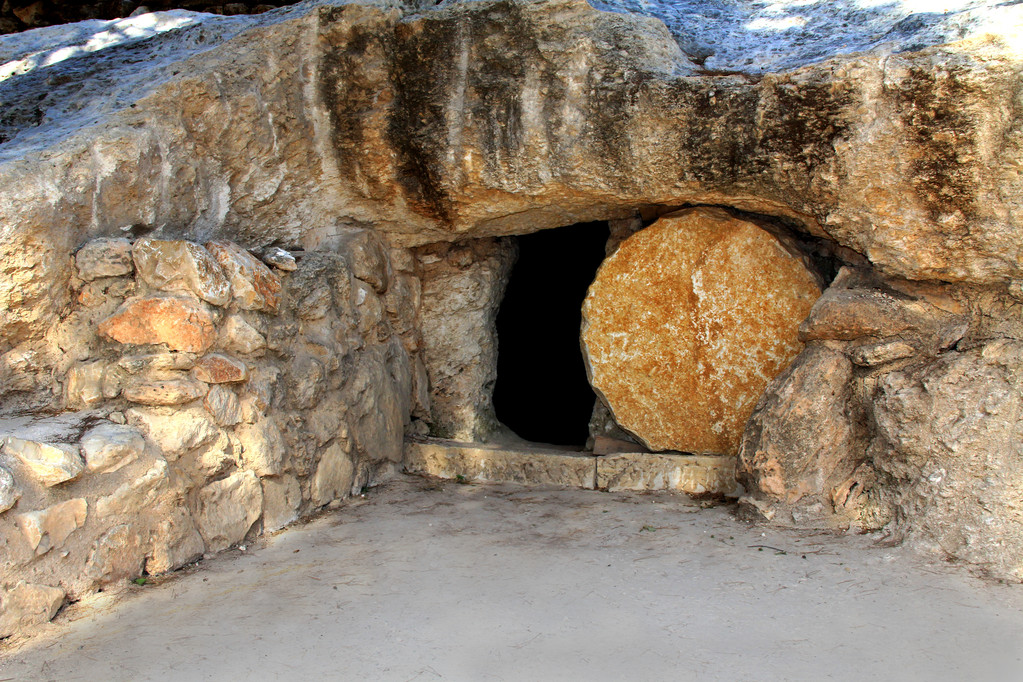
Christ Died and Was Buried
Series: John, After the Farewell Discourse Passage: John 19:31–42
Introduction
Many of you are probably familiar with Joe Rogan. He’s hosted TV shows like Fear Factor, he’s been commentator for UFC, and his podcast is extremely popular. He has 20 million subscribers just on YouTube. But he did not build his brand by trumpeting Christian values, and you shouldn’t listen to his podcast because the language is bad.
But Joe Rogan has become fascinated with Christianity. He had Wesley Huff, a Christian apologist, on his show this spring and was clearly intrigued by what Huff said. And recently he said he’s going to church. He said, “The place I go to, they read and analyze passages in the Bible. I’m really interested in what these people were trying to say.” He added, “There’s a lot of, like, atheists and secular people that just like to dismiss Christianity as being foolish. You know, ‘It’s just fairy tales.’ I hear that amongst, you know, self-professed intelligent people, like, ‘It’s a fairy tale.’ Like, I don’t know if that’s true. I think there’s more to it. I think it’s history, but I think it’s a confusing history. … [But] I think there’s something to what [the biblical authors were] saying. Christianity in particular is the most fascinating to me because there’s this one person that everybody agrees existed, that somehow or another had the best plan for how human beings should interact with each other and behave and was the best example of it and even died in a nonviolent way, like didn’t even protest, died on the cross supposedly for our sins.”
That’s fascinating. He’s seeing that Christianity is more credible and compelling than many people want to admit. He’s not alone. God is moving among many people like Rogan, and we need to go find them with the gospel.
But what’s especially important for our purposes is that if the Gospels are true, and Jesus died for our sins and rose again, ignoring him is not an option. And John is here to say it is true (v. 35). Jesus really died. He rose again, and you must believe. I hope you will. And if you already do, I hope this text will strengthen your faith and your resolve to stand for Jesus. Our passage emphasizes two essential realities—Jesus died and Jesus was buried.
I. Jesus died (vv. 31–37).
The fact that Jesus died may seem so obvious that we don’t need to discuss it, but some have tried to dismiss the resurrection with the so-called swoon theory. It says Jesus didn’t truly die; he just passed out and woke up 3 days later. Our text makes we wonder if John heard the same silliness.
We also know that by the time John wrote, a heresy called Docetism was on the rise. It said Jesus only appeared to be human. He didn’t truly become a man or die. But John won’t have it. The gospel depends on the true death and resurrection of Jesus. And John demonstrates they really happened.
So, after Jesus died, John shifts from the cross back to the Praetorium. The Sanhedrin wanted the 3 men off the cross because the Sabbath began at sunset, and it was a special Sabbath because it was Passover week. They wanted the 3 men off the cross before sunset.
That’s because, “If a man has committed a sin worthy of death and he is put to death, and you hang him on a tree, his corpse shall not hang all night on the tree, but you shall surely bury him on the same day (for he who is hanged is accursed of God), so that you do not defile your land which the Lord your God gives you as an inheritance” (Deut 21:22–23).
The law is good, but isn’t it ironic that they were so focused the Passover festivities that they missed their Messiah? Israel had waited 1500 years for the true Passover Lamb, and he’s on a cross, outside town dying for them. But they don’t see it. Don’t you make the same mistake.
But since the Jews are focused on the feast, they ask Pilate to break the 3 men’s legs. The Romans occasionally did this because some people could endure crucifixion for days. If the Romans wanted to speed it up, they would break their legs. That’s because a man on a cross must push himself up to breath. But once his legs were broken, he quickly suffocated.
Pilate complied, and his soldiers probably used an iron mallet to break 2 of the 2 thieves’ legs. In 1968, archaeologists found a skeleton north of Jerusalem that endured this. One leg was fractured, and the other was shattered. Pilates’s men did the same to the two thieves. Very quickly one was in hell, but the one who repented was with Jesus in paradise.
That’s because Jesus was already dead, and it was obvious to the soldiers. Jesus had been scourged twice. His body was severely compromised before he even reached the cross. Then Jesus didn’t grasp for life. He finished redemption. Then v. 30 said he “gave up His spirit.” He let it go. So, there was no need to break Jesus’ legs.
But just to be sure Jesus was dead, one of the soldiers drove his spear into Jesus’ side. He probably didn’t think much of it, but there are no accidents with God. God used him to make a profound point.
That’s because when the spear pierced Jesus, it released a gush of blood and water that flowed from Jesus’ side. And God used that flow to make a few important points.
First, in defiance of Docetism, God proved that Jesus really was a man with human blood. And in defiance of the swoon theory, God proved that Jesus really died. His body fluids had settled. And lest you doubt either of these, John inserts an exclamation point with v. 35. He’s saying, “I was there. I watched all this happen. I’m telling the truth about real historical events.”
Why? “So that you may believe.” If this is a fairy tale, we might as well go home. We don’t need to waste our time with existential feelings. But it’s not. John is telling the truth. Jesus was fully man, and he died for us. It changes everything.
Beyond that, blood and water symbolize a couple vital gospel realities. First, Hebrews 9:22 says, “without shedding of blood there is no forgiveness.” So, Jesus became the Lamb of God, and he shed his blood for us.
Our world is increasingly sheltered from death. Most people have never killed their food, and more and more people have never been around death. So, they get antsy about the blood of Christ. It seems gross and dark. But we should rightly celebrate Jesus because the Scriptures do, and it is our life.
So, rejoice when we sing, “There is a fountain filled with blood drawn from Immanuel’s veins; and sinners plunged beneath that flood lose all their guilty stains.” Or “Jesus keep me near the cross—there a precious fountain; free to all, a healing stream flows from Calvary’s mountain.” Or “Rock of Ages, cleft for me; let me hide myself in Thee. Let the water and the blood from thy riven side with flowed be of sin the double cure—save from wrath and make me pure.” Or, “Your blood has washed away my sin, Jesus, thank you.”
Jesus’ death was awful and violent, but it is our life. You have forgiveness because Jesus’ blood was poured out at the cross. Praise Jesus!
Maybe you are bearing an awful weight of guilt. You’ve done some horrible things, and you are grasping for a way to pay for your sin and get that guilt off your back. The good news of the gospel is that you don’t have to pay for your sin. Jesus shed his blood so he could wash away your sin. We’d love to talk with you about how Christ can remove your burden of guilt, how you can be forgiven in Christ. Please talk us. Please come to Jesus.
But what about the water? Did John see any significance in that? Based on John 7:37–39, I believe the answer is yes (read). Jesus described the future gift of the Spirit as a life-giving stream of water. And I believe John saw the flow of water as a symbol of the gift that was coming. We talked a lot in chapters 14–16 about the Spirit’s impact. Jesus said the indwelling Spirit will be more impactful than the bodily presence of Jesus. That’s huge!
So, rejoice that the Spirit has come. He is like rivers of living water, empowering you to serve Christ. That’s precious.
So, as John stood at the cross and watched the flow of blood and water, he saw some massive symbolism. Then he adds two more important implications of that scene. First, this scene demonstrated that…
Jesus is the true Passover lamb (v. 36). Again, the soldiers simply made a practical choice. They didn’t need to break Jesus’ legs because he was already dead. But God used them to fulfill Scripture.
In Exodus 12 God told Israel how to observe the first Passover. Every family must kill a Passover lamb and paint the door to escape the death angel. And v. 46 says, “It is to be eaten in a single house; you are not to bring forth any of the flesh outside of the house, nor are you to break any bone of it.”
For roughly 1500 years, Israel carefully slaughtered Passover lambs without breaking any bone. Then during Passover week, Jesus died as our substitute. And John knew it was no accident that the soldiers didn’t break Jesus’ legs. No, it was God’s confirmation that Jesus is the true Passover lamb.
That’s huge! Hebrews 10:4 says, “It is impossible for the blood of bulls and goats to take away sins.” But Jesus is not your typical lamb. He is the infinite, perfect Son of God. So, Hebrews 10:14 says, “By one offering He has perfected for all time those who are sanctified.”
Aren’t you glad we don’t need to offer sacrifices, and we don’t have a guilty conscience? Jesus is the true Passover lamb. He has washed away our sin. Then John saw one other important implication of that scene.
Jesus is the promised Messiah (v. 37). John quotes an important prophecy in the book of Zechariah that we’re going to talk about a lot in our dispensationalism series. This prophecy looks ahead to the last days. The nations will gather to fight against Israel, and when all hope seems lost, Jesus will return and destroy all Israel’s enemies.
Then Zechariah 12:10 says, “I will pour out on the house of David and on the inhabitants of Jerusalem, the Spirit of grace and of supplication, so that they will look on Me whom they have pierced; and they will mourn for Him, as one mourns for an only son, and they will weep bitterly over Him like the bitter weeping over a firstborn.”
Someday, Israel will behold the Messiah whom they pierced, whom they crucified, and they will repent. Obviously, that hasn’t happened yet. But John saw that God had prophesied some 500 years prior that Messiah would be pierced, and he was just as God said.
Jesus didn’t force it or the prophecy of v. 36. He was dead! No, God did these things because he gave the prophecies, and then he fulfilled them. Jesus is the promised Messiah.
And John watched all of this. He has told you the truth “so that you may believe.” So, I want you to behold the image John has persevered. See Jesus, hanging on a cross. He is truly a man, and his body has been brutalized by the Romans. He’s as dead as dead can be.
But he’s also truly God. God proved that by fulfilling multiple prophecies. And Jesus poured out his blood for you. It happened. So, do not dismiss Jesus as a fairy tale. You must respond. You must believe. You can be saved right now, if you repent of your sin and receive Jesus as your Lord and Savior. Just cry out to God. Tell him you believe. You want to turn from your sin and follow Jesus. The blood of Jesus will wash away your sin, and Christ will change your life. Please, come to him today and be saved.
And Christian, use this passage to renew your faith. Jesus has washed away your sin. Your guilt is gone. Someday, you will look on the one who was pierced for you. You will reign alongside him in his kingdom. You believe, but the Spirit wants to to make your faith even stronger. So, vv. 31–37 demonstrate definitively that Jesus died. Then vv. 38–42 demonstrate that…
II. Jesus was buried (vv. 38–42).
John’s Gospel is all about faith, and John warns us throughout his Gospel that all faith is not created equal. For example, after Jesus preached a hard message 6:66 says, “Many of his disciples withdrew and were not walking with him anymore.” They had some faith but not true saving faith that transforms your life.
Before the crucifixion that seems to have been both Joseph of Arimathea and Nicodemus. Joseph had been “a disciple of Jesus, but a secret one for fear of the Jews.” The other Gospels say Joseph was wealthy, and he was a member of the Sanhedrin. In other words, he had a lot to lose by publicly identifying with Jesus. Luke says he didn’t “consent” to Jesus’ crucifixion, but apparently he did not publicly resist it either.
Nicodemus was similar. John 3 says he was “a ruler of the Jews” (v. 1), and Jesus called him “the teacher of Israel.” He was apparently a very prominent member of the Sanhedrin. Like Joseph he was sympathetic to Jesus, but he wasn’t willing to publicly identify with him.
In John 3, he came to Jesus in the dark of night, not the light of day. He acknowledged that Jesus “has come from God,” but he was unwilling to be born again. Later in John 7, the Pharisees discussed arresting Jesus. Nicodemus had the courage to say Jesus deserves a fair trial, but he didn’t have the courage to say Jesus is Messiah.
However, God apparently used the crucifixion to push both men to a new level of faith, to boldly identify with Jesus. They courageously requested the body of Jesus and to give him a proper burial.
You must understand that this would anger their friends on the Sanhedrin. They hated Jesus and wanted him humiliated. And we know the Sanhedrin heard about their request because they asked Pilate if they could put a guard at Jesus’ tomb. But Joseph and Nicodemus didn’t care. They were ready to identify with Jesus no matter the cost.
That’s real faith. You must imitate their example. Maybe you are shy about your faith because you want people to accept you and respect you. So, remember that Jesus hung naked on a cross for you. You should be ashamed every time you shrink from the shame of Christ. Stand for Jesus the way he died for you.
That’s what these men did. Joseph used his leverage as a wealthy member of the Sanhedrin to ask Pilate for Jesus’ body. Typically, the Romans would leave crucified bodies to be eaten by vultures, but the Jews wanted the bodies down. So, Pilate probably planned to put Jesus in a crude mass grave. He was probably surprised by the request, but he “granted permission.”
While Joseph was appealing to Pilate, Nicodemus was responsible to buy spices. He bought a lot of spice. The Greek says he purchased 100 litras or roughly 65-75 English pounds of myrrh and aloes. It’s not an unbelievable amount, but it’s certainly more than was typical for a common man. It demonstrates how much Nicodemus has come to revere Jesus. He didn’t do the minimum. He wanted to honor Jesus in his death.
So they came (to the cross).” And probably with the help of some servants, they took Jesus’ body down. Based on Jewish custom, they probably washed his body, and then they began to bind him with “linen wrappings with the spices.” With that much spice, they were able to pack the body well, and they probably had enough to put spice underneath and around the body.
Of course, they were on a time crunch. They had to be done by sunset. So, they probably worked relatively quickly. That’s probably why the women planned to return after the Sabbath. Matthew says that Mary Magdalene watched all this, and they wanted to do more. They wanted to honor Jesus well in his death, and there wasn’t time to do that fully before the Sabbath. But Joseph and Nicodemus did the best they could with the time they had. They took great care to honor Jesus in his death.
Then they placed Jesus’ body in the tomb. John says it was a new tomb in a garden that was very near the cross, which was very convenient considering the time crunch. Matthew says it was “(Joseph’s) own new tomb, which he had hewn out in the rock.” That means this was an expensive tomb. Joseph is offering a precious gift.
Joseph and Nicodemus loved Jesus, and they showed it. May the Lord give each of us hearts to honor and revere the Lord like these men. Jesus does not deserve the scraps of your love, your attention, your time, or your budget. He deserves the very best. You need to make him the priority that Joseph did.
So, they put the body in the tomb, and Matthew adds, “He rolled a large stone against the entrance of the tomb and went away.” All of them went home to observe the Sabbath.
Of course, the story is not done. Sunday is coming! But Sunday is meaningless unless Jesus truly died. So, John wants you to know that Jesus died, and Jesus was buried.
This is not just a cute tradition, a great story to tell around Easter. No, God became a man, and Jesus died. Friday night, all day Saturday, and Sunday morning, Jesus body lay cold as can be in the dark of that cave, and it began to decay. And this fact changes everything. You must believe.
Don’t dismiss Jesus as a fairy tale. You must believe. Jesus will wash away your sins with his blood, and he will transform your life with the Spirit. Please see Jesus and believe.
And Christian, And you have a choice to make. Will you be the casual disciples that Joseph and Nicodemus where before, or will you be the serious disciples they became. Jesus gave everything to you on the cross. So, stand boldly with Jesus. Give everything to him. Live for Jesus the way he died for you.
other sermons in this series
Dec 14
2025
Friendship for a Lifetime
Pastor: Kit Johnson Passage: John 17:17 Series: John, After the Farewell Discourse
Nov 30
2025
Grief to Joy
Pastor: Kit Johnson Passage: John 20:11–18 Series: John, After the Farewell Discourse
Nov 16
2025
Believe in the Resurrection
Pastor: Kit Johnson Passage: John 20:1–10 Series: John, After the Farewell Discourse